 Lutje
Poor Clare Sisters
The community of the Poor Clare Sisters at the St Clare Monastery in Shkodër: a life of prayer in the footsteps of St Clare of Assisi.


Explore: Poor Clare Sisters
- A Short History LatestArsyeja e pranisë sonë këtu
- The monastery today LatestLutja e bashkësisë
- House of Friends Today the monastery is a destination for many people, lay and religious alike, who wish to stay in silence and…
- Events LatestPërkushtimi i kishës së “Shën Kjarës së asizit”
- Prayers LatestPerfundimi
- Contact Poor Clare Sisters, Shkodër, Albania Address: Monastery of St Clare (“Sh. Kjara”), Bulevard Skanderbeu, 25, Rruga M. Barleti Telephone: (+355) (0)222.48308/(+355) (0)69.2537970…
About us
St Clare of Assisi
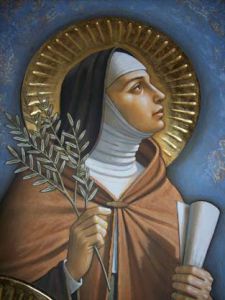 In 1209 Francis of Assisi went with his followers to Rome to ask Pope Innocent III to approve his form of Gospel life, the fulfilment of a life based on the example of the disciples of Jesus. This way of life was founded above all on following Jesus in poverty and brotherhood, in order to proclaim the Kingdom of God. Pope Innocent III granted the request orally. Shortly after the approval, the first woman aspirant to this order came forward: Clare Offreduccio, a fellow citizen of Francis of Assisi and daughter of a rich and noble family of Assisi. This young woman asked to follow the same path of poverty as Francis, according to the perfection of the Gospel, and he gladly accepted her. On the night of Palm Sunday, between 27 and 28 March 1211, in the church of the Porziuncola in the plain below Assisi (according to others it was the night of 18/19 March 1212), Francis and his friars cut Clare’s hair as a sign of a life totally consecrated to God and as her consecration.
Read moreLess
Francis gave the new sister a programme of life (forma vitae) based on this principle: following the Lord Jesus according to the perfection of the Gospel and according to the condition of woman, taking the Virgin Mary as model. This means living and realising the Gospel life as daughter and handmaid of the great Lord, the God of heaven and earth, as mother of the Lord Jesus and as his bride in the Holy Spirit (cf. Rule of St Clare 6:3), in the silence of a life consecrated to God in body and spirit (1 Cor 7:34). Clare embraced this “forma vitae” with enthusiasm and determination as a new way of life within the Church.
Clare’s example was soon followed by other young women: her younger sister Agnes, and new followers from the area, the first of whom came from Perugia and was called Sister Benvenuta, and many others. In the summer of 1212 five fellow sisters are mentioned, as well as other sisters whose names are not known (cf. Process of Canonisation of St Clare 1:43–57). The example of the life led by Clare in the monastery of San Damiano near Assisi was like a shining beacon, which gave rise there to the movement we call the Clarian movement or the Franciscan Second Order, through the founding of other monasteries. Between 1217 and 1219 nine monasteries are counted: Assisi, Spello, Foligno near Spoleto, Perugia, Arezzo, Siena, Florence, Lucca, Tortona (and others not named). When Clare died (11 August 1253), there were 115 monasteries in Italy and 50 outside Italy. At the beginning of the fourteenth century there were 413 monasteries. These monasteries were entered by simple people as well as by the daughters of wealthy families, of dukes, princes and kings (of France and of Bohemia).
The significance of this movement in the Church of that time was great. The Fourth Lateran Council concerned itself with it (November 1215, Const. XIII), and later Pope Honorius III (1216–1227). Pope Gregory IX (first as Cardinal and then as Pope) went several times to San Damiano to meet Clare and her sisters, each time issuing written documents. Likewise Pope Innocent IV went twice to San Damiano to meet Clare (at the beginning of May and in the first week of August 1253). He also wished to celebrate Clare’s funeral himself (12 August 1253) and ordered her body to be moved from San Damiano into the city, where a monumental church dedicated to the saint, who was canonised very soon afterwards, was later built by order of Pope Alexander IV.
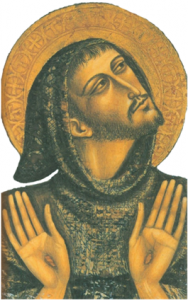 Clare was the first woman to write a rule of life for women, and she asked for it to be approved by Pope Innocent IV himself, who without delay signed it with the bull “Solet annuere”. The request was made in the first week of August 1253 (perhaps on the 8th); the Pope signed it on 9 August and on the 10th sent it to San Damiano, addressed to Clare, who on receiving it devoutly kissed the letter, one day before she died, serene and at peace, having found her place in the Church. Clare was canonised in the new cathedral of Anagni on 15 August 1255 by Pope Alexander IV. She was proclaimed Patron Saint of Television by Pope Pius XII on 14 February 1958, because when she was ill in the monastery of San Damiano she had a vision that allowed her to be present at the Christmas Mass in the Basilica of St Francis in Assisi in 1252.
Other outstanding Poor Clare sisters of the early thirteenth century besides Clare (+1253) are: her sister Agnes (+1253), Filippa Mareri (+1236), Margherita Colonna (+1280) and Agnes of Prague (+1281/2). The most recent canonisation of a Poor Clare sister took place in October 2010: Sister Camilla Battista da Varano of the monastery of Camerino.
Today the monasteries of Poor Clare sisters throughout the world number more than a thousand, with about 12,000 religious, born of the “plantula beati Francisci” (the little plant of St Francis), including the Proto-monastery of St Clare in Assisi, the community that is heir to that of San Damiano founded by St Clare herself.

Source: https://kishakatolikeshkoder.com/en/poor-clare-sisters/