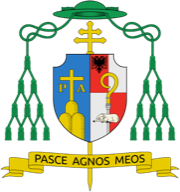
Curriculum vitae of Imzot Angelo Massafra O.F.M.
His Excellency Imzot Angelo Massafra was born on 23 March 1949 in San Marzano di San Giuseppe (Taranto), Italy. He received the Franciscan habit of the Order of Friars Minor of the Ionian-Salentine Province “of the Assumption of Our Lady” on 17 September 1965, made his novitiate at the Shrine of “Our Lady of Graces” in Galatone (Lecce) and, at its conclusion, made his first profession on 2 October 1966.
After the novitiate in Galatone, he completed his philosophical and theological studies in Lecce (Italy), at the friary of “St Anthony”, and on 13 October 1973 he made his solemn profession of the Rule of St Francis, while on 21 September of the following year he was ordained a priest.
In the first years of his priestly ministry he undertook various tasks entrusted to him by his superiors: besides assisting the brothers and sisters of the Secular Franciscan Order and serving in the prison of Manduria, he worked to spread the periodical “Salento Francescano” and took care of vocations promotion in his Province. Before leaving Italy for Albania, he also served as Director of postulants and of the post-novitiate. Moreover, faithful to the missionary spirit that has always characterised him, he took part in numerous popular missions organised in several Italian cities.
The opening of Albania’s borders led him to ask his superiors to be allowed to go to Albania as a missionary, where he settled definitively in August 1993, after having had several missionary experiences and a period of preparation for the mission in the two preceding years.
His first task, besides pastoral and parish work among the Christian communities of Troshan and Fishtë, was that of formator of young candidates for Franciscan religious life, as “Novice Master of the reborn Province of the Friars Minor in Albania” at the friary of Lezhë, until on 6 December 1996 he was appointed Bishop of the Diocese of Rrëshen and Apostolic Administrator of Lezhë; on 6 January 1997 he was ordained a bishop by St John Paul II in St Peter’s Basilica in the Vatican.
On 28 October 1997, after the death of Archbishop Frano Illia of Shkodër, he was appointed Apostolic Administrator of the Archdiocese of Shkodër and of the Diocese of Sappa, until on 28 March 1998 he was appointed Metropolitan Archbishop of Shkodër and Apostolic Administrator of Sappa.
On 20 September 2000 he was appointed by the Holy Father, for two five-year terms, a member of the Pontifical Council “Cor Unum”, in which he took part until 2012. On 16 June 2003 he was also appointed by Pope John Paul II a Consultor of the Congregation for the Evangelization of Peoples, an office that was conferred on him again by Pope Francis on 2 June 2020.
In 2005, on 25 January to be precise, the Holy See decreed the union of the Diocese of Pult with the Metropolitan Archdiocese of Shkodër under the new name of Archdiocese of Shkodër-Pult, and Imzot Massafra thus became Archbishop of Shkodër-Pult.
From 2000 to 2006 and from 2012 to 2018 he served as President of the Episcopal Conference of Albania, to whose leadership he returned on 4 February 2021. Within it he shows particular care for the fields of education, sport and youth work, as well as for interreligious dialogue.
Since June 2017 he has also held the office of President of Caritas Albania.
From 2014 to 2016 he was Vice-President of the Council of the Bishops’ Conferences of Europe, and in 2017 he took on the presidency of Caritas Albania; finally, since February 2018 he has been a member of the Justice and Peace Commission of the Council of the Bishops’ Conferences of Europe.
The reorganisation of the Albanian Church was his principal commitment at the beginning of his episcopal ministry: providing the necessary services, working for the care of vocations, restoring or building destroyed churches so as to give the Christian communities worthy sacred places, and giving new life to charitable assistance, which was greatly needed, especially in the early years.
Numerous charitable works of the Church and of religious congregations came into being during his episcopal ministry. Among them, mention should be made of the “Village of Peace” at the foot of Mount Tarabosh in Shkodër, set up to receive the refugees of the Kosovo war of 1999, which was followed by other initiatives connected with the theme of peace, such as the day organised every January in cooperation between the Diocesan Office for Justice and Peace and the Community of Sant’Egidio, which also involves the Orthodox Christians and Muslims present in the territory of the Archdiocese. He has also been a supporter of the “Projekti Shpresa” (Project Hope) in Shkodër, founded by Mrs Silvana Vignali, and of various initiatives for people with disabilities, such as the summer camps in Velipojë.
He made the Archdiocese’s property in Razem, beside a small church dedicated to St Veneranda, habitable so that it could host groups in summer for formation and rest.
Again in the field of Charity and of Justice and Peace, faithful to his episcopal motto, he has personally supported and made possible the reconciliation of many families caught up in blood feuds.
In this field he has been particularly involved, encouraging meetings, fostering dialogue on themes of common interest and public statements in the name of all the faiths, as in 2017 on the occasion of the country’s parliamentary elections. It is also worth mentioning that the cooperation and involvement of the religious leaders proved precious, as on 20 January 1998, when he succeeded in bringing peace to Shkodër at a very delicate moment that Albania was experiencing in those years, at risk of a civil war that could have led to a religious war, and at the time of the Kosovo war, with joint initiatives to help the refugees and to raise the population’s awareness of the need for a welcome marked by solidarity.
For all these merits he was honoured with the “Mother Teresa” title by the President of the Republic of Albania, Mr Ilir Meta, on 27 June 2018.
He has carried out two pastoral visitations: the first in 2000–2002 and the second in 2006–2009. A third pastoral visitation began in 2018.
He has brought out two publications: “Pajtohuni me Hyjin” (Be reconciled to God, 2002), on the first five years of his archiepiscopal ministry in a delicate climate in Albanian history, and “Dhuratë dhe Angazhim” (Gift and Commitment, 2016), which tells of the Church of Shkodër-Pult in the transition between two millennia after the communist storm.
Four pastoral letters have been published: “Ati na pret t’i dalim përpara” (The Father is waiting for us to go out to meet him, 1999), “Ju dua të gjithëve në Jezu Krishtin” (I love you all in Christ Jesus, 2002), “Atë që soditëm… ne e kumtojmë” (What we have contemplated… we proclaim, 2006) and “Gëzimi i dëshmisë” (The joy of witness, 2017).
He personally oversaw the diocesan periodical “Fjala e Paqes” and the magazine “Kumbona e së Dielës”, previously directed by the late Bishop Lucjan Avgustini, as well as the editing and publication in Albanian and Italian of the biographies written by Father Leonardo Di Pinto O.F.M., “Vinçenc Prenushi and 37 companion martyrs of the 1900s”, Blessed since 5 November 2016; and he was President of the Ecclesiastical Tribunal for the cause of canonisation of the 40 Servants of God – the Albanian Martyrs – killed during the communist dictatorship, which began on 10 November 2002 and ended on 8 December 2010.
He saw to the publication in Albanian of various Church documents, including the “Compendium of the Social Doctrine of the Church”, the Documents of the Second Vatican Ecumenical Council and the recent papal encyclicals, in order to promote them and spread them among Catholics. The Pope’s annual Message for the World Day of Peace has also been translated and distributed, especially to the country’s political class and to religious leaders.
His cultural commitment does not stop at publications: he has also been a promoter of Radio Maria in Albania. He served as adviser to several documentaries devoted to Gjon Buzuku, Frang Bardhi, Pjetër Bogdani and others. In addition, he succeeded in completing the construction of the Diocesan Museum of Shkodër-Pult, inaugurated on 2 July 2016: a long and carefully curated project with collections of finds from the Albanian Catholic tradition, both from ancient and from recent times, including those of the communist period, recovered from the destruction and plunder of the dictator and returned to the Catholic Church.