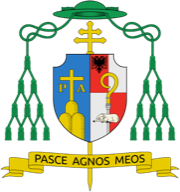
Imzot Ernest Çoba was born on 16 February 1912 into an old town family of Shkodër. He completed his primary and secondary education at the Pontifical Seminary. He was ordained a priest on 9 February 1936. He held various posts at the Pontifical Seminary where he had been trained, and also served as a teacher of religion in the schools of the city. After the death of Imzot Gaspër Thaçi and the arrest of Dom Mikel Koliqi, he served at the same time as assistant parish priest and parish priest of Shkodër. He was one of the bishops ordained at the most critical time for the Church, when attempts were being made to sever it from the Holy See. The only bishop still alive and not in chains, Imzot Bernardin Shllaku, together with the Bishop of Durrës, Imzot Pjetër Dema, ordained Imzot Ernest Çoba on 20 April 1952.
He wore red liturgical vestments at a time when this colour symbolised the blood of his brothers, shed without measure in desolate places for Faith and Fatherland. He took up a mission much like that of the first bishops of Christianity, who very often deepened the red of their vestments by staining it with the blood they shed in the amphitheatres in order to remain faithful to Christ and to his Vicar on earth, the Pope of Rome. Shortly after his ordination Imzot Shllaku died. The Diocese of Shkodër, which since its separation from the Diocese of Antivari (Tivar) had had five great bishops – Imzot Karl Pooten, Pashko Guerini, Jak Serreqi, Lazër Mjeda and Gaspër Thaçi – was left in the hands of the gentle and kindly bishop, a living symbol of Christian love, Imzot Ernest Çoba.
This is how he is described by Imzot Zef Simoni, auxiliary bishop of Shkodër after the fall of the communist dictatorship, in his book “Portrete klerikësh katolikë” (Portraits of Catholic clerics):
“Imzot Ernest Çoba was short in stature, with lively eyes, half hidden behind dark glasses when he served in church or in the office. He had fine qualities: he was humble, modest, calm, measured, tireless in service, even in tasks that did not belong to him as a bishop. Every day, after celebrating the six o’clock Mass, the Monsignor could be found at the bedside of the sick of the city, in their huts, bringing them the holy sacraments, or among the children at the mass catechism classes, when the great church hummed with children’s voices. This won him great popularity and affection, especially among the poor.
He was director of the association of the Little Crusaders run by the Jesuit Fathers, knew three foreign languages, was a specialist in moral theology and religious subjects and, no less, a practical priest in matters of faith and liturgy. He was unable to take part in the Second Vatican Council, but with his foresight he let the spirit of the Council permeate the whole life of the Church. He had the courage to gather a group of candidates for the priesthood and to ordain seven of them, as well as the courage to maintain close ties with the Holy See, making use of every possible means and channel.”
On the eve of the closure of the churches, on a bitter Sunday, when he had been summoned to be accused by the communist regime, Imzot Ernest Çoba turned accuser, delivering a fiery speech, like a sermon, in defence of the God under attack and of the churches on the brink of great destruction. Not long afterwards, however, the doors of the churches and of the other temples of God were closed. Imzot Ernest Çoba was then forced to return to his family. He left his father’s house in chains. It was 1976. The communist court sentenced him to 25 years’ imprisonment, as though he were the greatest of criminals. He was accused of having maintained contacts with the Holy See through the Italian legation.
He suffered with matchless patience, his only concern being to resemble Christ on Calvary as closely as possible, until he died in the prison hospital in Tirana on 8 January 1980. It was a mysterious death, as Imzot Simoni testifies in the book mentioned above. He closed his eyes after an injection given to him in the first days of January 1980, a few days before the feast of St Ernest. His figure has been written about several times, but no serious effort has yet been made to gather the testimonies of his heroic stand and his end.
(from Vatican News)